
Documents et outils
La page « Documents et outils » de l'ARES vous permet de rechercher et d'accéder facilement aux documents, médias et outils essentiels liés à l'enseignement supérieur en Fédération Wallonie-Bruxelles.
Comment optimiser votre recherche ? Indiquez un ou plusieurs mots-clés, puis affinez les résultats à l'aide des filtres (ou inversement) OU utilisez les guillemets pour chercher une expression exacte.
Il est possible de réinitialiser la recherche en supprimant les critères de filtres.
8 résultat(s)
8 résultat(s)
Universities in Action: Adapting Support, Strengthening Integration, Defending Freedom
Event by the Scholars at Risk section in the Wallonia-Brussels Federation – "Universities in Action: Adapting Support, Strengthening Integration, Defending Freedom", June 3d, 2025, Brussels
In a world where academic freedom is increasingly under threat, an event organised in Brussels by the Scholars at Risk section in the Wallonia-Brussels Federation (SAR FWB) brought together academic institutions, public actors, and international organisations around a common goal: to strengthen support systems for at-risk researchers and reaffirm universities’ commitment to academic freedom.
Three main themes structured the discussions: how to adapt support mechanisms to the realities of displaced researchers, how to foster their long-term integration into French-speaking academic communities, and how to uphold academic values in international partnerships.
The discussions highlighted deep human challenges faced by displaced individuals: loss of academic recognition, emotional uprooting, and pressure for rapid integration. International, European and local programs were presented, showcasing various approaches - from emergency hosting to long-term support - with particular attention to language, career transition, and mental health.
The event also raised sensitive questions: how to approach partnerships with institutions in countries where academic freedom is violated? How to distinguish individual collaborations from institutional commitments? And how to ensure that researchers themselves do not become collateral victims of these decisions?
This moment of collective reflection allowed for the sharing of inspiring practices, strengthening of synergies among stakeholders, and reaffirmation of a strong conviction: universities must remain places of refuge, dialogue, and rebuilding.
Download the full report in English
Les universités en action : adapter le soutien, renforcer l'intégration, défendre la liberté
Événement de la section Scholars at Risk en Fédération Wallonie-Bruxelles – « Les universités en action : adapter le soutien, renforcer l'intégration, défendre la liberté », 3 juin 2025, Bruxelles
Dans un monde où les libertés académiques sont de plus en plus menacées, un événement organisé à Bruxelles par la section Scholars at Risk en Fédération Wallonie-Bruxelles a réuni institutions académiques, acteurs publics et organisations internationales autour d’un objectif commun : renforcer les dispositifs d’accueil pour les chercheur·euses en danger et réaffirmer l’engagement des universités en faveur de la liberté académique.
Trois grands axes ont structuré les échanges : comment adapter les mécanismes de soutien aux réalités des chercheur·euses déplacé·es, comment favoriser leur intégration durable dans les communautés académiques francophones, et comment préserver les valeurs académiques dans les partenariats internationaux.
Les discussions ont mis en lumière des défis humains profonds rencontrés par des personnes déplacées : perte de reconnaissance académique, déracinement émotionnel, pression à l’intégration rapide. Des programmes internationaux, européens et locaux ont été présentés, illustrant des approches variées - de l’accueil d’urgence à l’accompagnement sur le long terme - avec une attention particulière portée à la langue, à la reconversion professionnelle et à la santé mentale.
L’événement a aussi soulevé des questions sensibles : comment aborder des partenariats avec des institutions dans des pays où la liberté académique est bafouée ? Comment distinguer les collaborations individuelles des engagements institutionnels ? Et comment éviter que les chercheur·euses eux-mêmes ne deviennent des victimes collatérales de ces décisions ?
Ce moment de réflexion collective a permis de partager des pratiques inspirantes, de renforcer les synergies entre acteur·rices, et de réaffirmer une conviction forte : les universités doivent rester des lieux de refuge, de dialogue et de reconstruction.
Télécharger le compte-rendu complet en français
Universities in Action: Defending Academic Freedom & Supporting At-Risk Scholars
Every day, scholars around the world face threats to their safety, their research, and their freedom to think, teach, and speak. Universities and other higher education institutions have a responsibility - not just to offer refuge, but to create real opportunities for these scholars to rebuild their careers and contribute to academic life.
On June 3d, 2025, in Brussels, join key academic leaders, experts, and at-risk scholars themselves for an essential conversation on how higher education institutions can effectively support at-risk scholars, foster their integration in a French-speaking academic environment, and uphold academic freedom in an increasingly challenging global landscape.
This event, co-organised by the members of the Scholars at Risk section in the Wallonia-Brussels Federation (CRef, ARES, ULB, UCLouvain, and ULiège), will offer inspiring insights, practical recommendations, and a space for meaningful exchange, culminating in a networking reception intended to build connections with peers and experts working at the forefront of academic freedom.
Programme highlights:
- Adapting support to crises: how can organisations and universities adapt their support mechanisms to the diverse and evolving crises faced by scholars at risk?
- Integrating scholars at risk in the French-speaking academic environment: what are the key barriers and good practices to the integration of displaced researchers in French-speaking institutions?
- Preserving academic freedom in partnerships: how can universities navigate the balance between international collaboration and ethical considerations?
Registration is mandatory – don’t miss out !
Secure your spot now by filling out the registration form.
Registrations are open until 20 May 2025.
We hope you’ll join us for this important discussion and we encourage you to share this event with anyone in your network who might be interested.
Universities in Action: Defending Academic Freedom & Supporting At-Risk Scholars
Every day, scholars around the world face threats to their safety, their research, and their freedom to think, teach, and speak. Universities and other higher education institutions have a responsibility - not just to offer refuge, but to create real opportunities for these scholars to rebuild their careers and contribute to academic life.
On June 3d, 2025, in Brussels, join key academic leaders, experts, and at-risk scholars themselves for an essential conversation on how higher education institutions can effectively support at-risk scholars, foster their integration in a French-speaking academic environment, and uphold academic freedom in an increasingly challenging global landscape.
This event, co-organised by the members of the Scholars at Risk section in the Wallonia-Brussels Federation (CRef, ARES, ULB, UCLouvain, and ULiège), will offer inspiring insights, practical recommendations, and a space for meaningful exchange, culminating in a networking reception intended to build connections with peers and experts working at the forefront of academic freedom.
Programme highlights:
- Adapting support to crises: how can organisations and universities adapt their support mechanisms to the diverse and evolving crises faced by scholars at risk?
- Integrating scholars at risk in the French-speaking academic environment: what are the key barriers and good practices to the integration of displaced researchers in French-speaking institutions?
- Preserving academic freedom in partnerships: how can universities navigate the balance between international collaboration and ethical considerations?
Registration is mandatory – don’t miss out !
Secure your spot now by filling out the registration form.
Registrations are open until 20 May 2025.
We hope you’ll join us for this important discussion and we encourage you to share this event with anyone in your network who might be interested.
Vade-mecum
Vade-mecum unique pour les projets académiques de la coopération de l'ARES
Cartographie
Cartographie des initiatives prises par les établissements d'enseignement supérieur en faveur des migrants, des réfugiés et des académiques et chercheurs en danger.
Microprojets étudiantes et étudiants 2025-2026
Appel à microprojets étudiantes et étudiants 2025-2026
/ Appel à microprojets étudiantes et étudiants
L'appel à microprojets étudiantes et étudiants est clôturé depuis le 16 mai 2025. Vous pouvez consulter les documents relatifs à cet appel à titre informatif.
Qui peut introduire une candidature ?
Deux groupes d’étudiantes et d'étudiants, régulièrement inscrits au sein d’un établissement d'enseignement supérieur (EES) de la Fédération Wallonie-Bruxelles (FWB) et dans un EES d'un pays partenaire de l'ARES. Ces deux groupes sont motivés par la dynamique partenariale et les thématiques liées au développement durable.
Pays éligibles ?
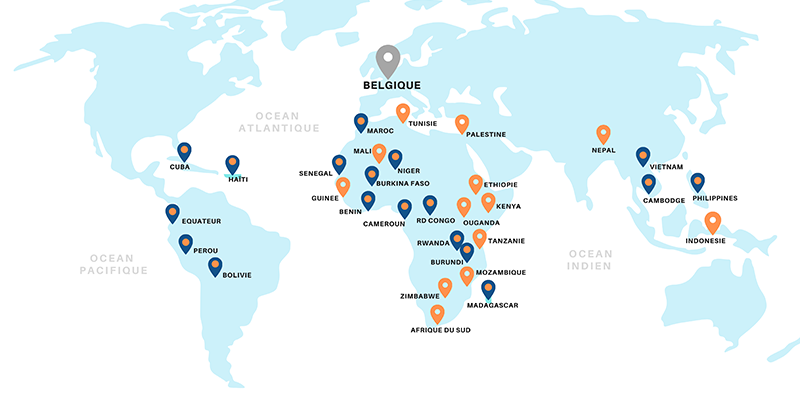
Carte des 18 pays partenaires de projets de l'ARES
Afrique du Sud, Bénin, Bolivie, Burkina Faso, Burundi, Cambodge, Cameroun, Cuba, Équateur, Éthiopie, Haïti, Indonésie, Kenya, Madagascar, Mali, Maroc, Mozambique, Népal, Niger, Ouganda, Pérou, Philippines, Territoire palestinien, République démocratique du Congo, République de Guinée, Rwanda, Sénégal, Tanzanie, Tunisie, Vietnam, Zimbabwe.
Durée ?
Le microprojet doit se dérouler sur une année académique, entre le 1er septembre de l'année X et le 31 août de l'année X+1.
Budget ?
20 000 €, y compris 10% de frais de gestion.
Détails de l’appel
Télécharge le document d'appel 2025-2026, pour un projet à réaliser entre le 1er septembre 2025 et le 31 aout 2026.
Contenu de la proposition
Le microprojet :
- doit être fondé sur un véritable partenariat ;
- doit démontrer une participation effective des étudiantes et étudiants de chacun des deux groupes ;
- doit mettre l’accent sur la sensibilisation des étudiantes et étudiants aux problématiques du développement durable plutôt que sur les résultats concrets attendus du projet ;
- doit démontrer son caractère collectif, en ce sens qu’elle ne peut pas, par exemple, déboucher sur la réalisation d’un unique mémoire/travail de fin d’études.
Les étudiantes et étudiants d’un EES de la FWB ayant obtenu une bourse de voyage de l’ARES peuvent être impliqués dans un microprojet de la même année académique, pour autant que la bourse de voyage ne soit pas octroyée pour effectuer un voyage dans le cadre du microprojet.
Comment soumettre sa candidature ?
En ligne via la plateforme GIRAF. Pour disposer du lien d’accès et des consignes pour l’introduction de la candidature, adresse-toi à la personne de référence de ton établissement.
Critères de sélection
- Qualité de la proposition :
- Adéquation de la proposition avec les caractéristiques d’un microprojet
- Développement d’un point de vue critique soutenu par des acteurs compétents (académiques, ONGs, diaspora, etc.)
- Pertinence et cohérence des actions proposées par rapport aux résultats attendus du microprojet µ
- Gage(s) de qualité du partenariat
- Développement d’une stratégie de diffusion et de partage de l’expérience vécue
- Modalités de mise en œuvre :
- Degré d’intégration des partenaires (FWB et du pays partenaire) dans la réalisation du microprojet (répartition des tâches, organisation du travail, etc.)
- Adéquation du budget par rapport à la réalisation du microprojet
Calendrier
10 février 2025 : Lancement de l'appel à microprojets
10 février - 16 mai 2025, à 12h : Introduction des candidatures via la plateforme GIRAF
30 juin 2025 : Information aux candidat·es sur les projets sélectionnés et non sélectionnés
1er septembre 2025 au 31 aout 2026 : Déroulement des projets
EN SAVOIR + :
- à l’ARES, contacte Camille Roegiers (ARES) - camille.roegiers@ares-ac.be ;
- au sein de ton établissement, contacte les personnes de référence (cellule de coopération/relations internationales).